# Introduction

Keiko Finance is a permissionless CDP protocol deploying on the Hyperliquid network where you can open a collateralised debt position and mint KEI against different assets of the Hyperliquid ecosystem.

The protocol enables users to create collateralized debt positions (CDP). Which means you can deposit certain supported assets from the Hyperliquid ecosystem as collateral and, in return, borrow a stablecoin called KEI. KEI is designed to maintain a stable value, making it useful for various financial activities.

Here's how it works in simpler terms:

1. Users deposit their supported Hyperliquid based assets into the Keiko Finance system.
2. Based on the value of these deposited assets, users can borrow KEI.
3. The borrowed KEI can be used for various purposes - trading, investing, or even day-to-day transactions.
4. Users can repay their KEI loan at any time to reclaim their deposited assets.


# KEI Stablecoin

KEI Stablecoin is an over-collateralized debt token issued by the Keiko Protocol. KEI can be minted by depositing collateral into a vault.

**Hard Price Ceiling**

The KEI Protocol sets a natural price ceiling for KEI at $1.10, based on its policy of a 90% maximum Loan-to-Value (LTV) ratio for some assets. \
\
Should the KEI exchange rate rise above this mark, borrowers have the opportunity to immediately benefit by taking out the maximum loan possible against their collateral and then selling their KEI for over $1.10 in the marketplace. \
\
For instance, if 1 KEI is valued at $1.20, an individual could secure $2200 worth of their chosen collateral, borrow 2000 KEI, and sell it for $2400. This action results in a guaranteed arbitrage profit of $200, even if the collateral is eventually liquidated.

**Hard Price Floor**

The ability to redeem KEI for collateral enforces a hard price floor, below which arbitrage opportunities become profitable.

These mechanisms are referred to as "hard peg mechanisms" since they rely on direct intervention processes.\
\
You can learn more about the Keiko's redemption mechanism on the Redemption Page.


# Collateral Tokens

Within the KEI Protocol, "Collateral Tokens" refer to a select group of assets from the Hyperliquid ecosystem that are eligible to be used as collateral for minting KEI Stablecoin. These tokens are integral to the functioning of the KEI Protocol, providing the necessary security and value backing required for stablecoin issuance.\
\
HYPER being the flagship token of the Hyperliquid Blockchain will serve as Keiko's primary collateral token with an attractive Loan-to-Value (LTV) ratio of 90%, making it a cornerstone in the collateral framework of the Keiko Protocol. By allowing such a high percentage of borrowing capacity the protocol allows users to leverage their holdings efficiently while maintaining robust security measures.<br>

### Expansion of Collateral Options

As the Hyperliquid ecosystem matures, KEI Protocol plans to support additional tokens as part of its collateral portfolio. The inclusion of new tokens will be carefully considered, based on comprehensive protocol security measures and empirical data analysis. The LTV ratios for these new tokens will vary, reflecting their respective market behaviors and risk profiles. This strategic approach ensures that the expansion of collateral options remains aligned with maintaining the stability and integrity of the KEI Stablecoin.


# Vaults Overview

A vault functions as a specific container within which you can place collateral to borrow KEI and manage your loan. Each vault is associated with a unique EVM address, and only one Vessel per collateral type is allowed per address. If you've used Vaults or Collateralized Debt Positions (CDPs) on other platforms, vaults operate under a similar principle.

### Collateral Ratio and Loan to Value

The terms Collateral Ratio and Loan-to-Value (LTV) ratio are both used to describe the relationships between the collateral, the borrowed amount, and the value of the collateral. Understanding the distinction between these two concepts is crucial for users who want to maintain a healthy position in the protocol.<br>

#### Collateral Ratio

The Collateral Ratio represents the percentage ratio of the total value of the collateral to the total value of the borrowed amount. This metric shows the extent to which the borrowed amount is backed by the collateral, highlighting the level of risk for a specific loan.<br>

$$
CR = (Collateral Value / Debt Value) \* 100
$$

#### Loan to Value

The Loan-to-Value (LTV) ratio is the percentage that describes the total value of the borrowed amount relative to the total value of the collateral. This ratio is used to indicate how much of the collateral's value is being utilized in the borrowing, reflecting the coverage level of the loan by the collateral.<br>

$$
LTV = (DebtValue / CollateralValue) \* 100
$$


# Collateral Parameters

### HYPE

* MCR Range: 110% - 160%
* Base Fee: 2.5%
* Max Fee: 14%
* Minimum Debt: 300 KEI
* Liquidation Penalty: 30%

### wstHYPE

* MCR Range: 120% - 170%
* Base Fee: 4.0%
* Max Fee: 17.5%
* Minimum Debt: 300 KEI
* Liquidation Penalty: 30%

### LHYPE

* MCR Range: 150% - 220%
* Base Fee: 5.5%
* Max Fee: 15.0%
* Minimum Debt: 300 KEI
* Liquidation Penalty: 30%

### PURR

* MCR Range: 150% - 220%
* Base Fee: 7.0%
* Max Fee: 15.0%
* Minimum Debt: 300 KEI
* Liquidation Penalty: 30%

### UETH

* MCR Range: 120% - 160%
* Base Fee: 4.0%
* Max Fee: 12.5%
* Minimum Debt: 300 KEI
* Liquidation Penalty: 30%


# Vault Management

This section provides a comprehensive, step-by-step guide on how to effectively manage a Keiko vault. If you're new to borrowing protocols, this tutorial will introduce you to the key concepts necessary to begin your journey with Keiko. By following these instructions, you'll gain a solid understanding of vault creation, maintenance, and risk management strategies.

Key Topics Covered:

1. Creating a vault
2. Selecting an appropriate Minimum Collateralization Ratio (MCR)
3. Borrowing KEI
4. Monitoring vault health
5. Adjusting your position to avoid liquidation


# Creating a Vault

## Creating your first vault

To create a vault and mint KEI, navigate to the 'Manage Vault' section in the sidebar. There, you will find a box labeled 'Borrow KEI'. Within this interface, input the amount of collateral you wish to deposit and specify the amount of KEI you intend to borrow.\
\
Remember the amount of KEI you can borrow depends on the value of the collateral you deposit

<figure><img src="/files/PapTK2b98EGSpHmjcb3q" alt=""><figcaption><p>Adding 500 Collateral (worth $3000 dollars) and borrowing 2000 KEI</p></figcaption></figure>

After inputting your desired values, click the "Approve Token" button to authorize Keiko contracts to access your collateral. Subsequently, you will see a "Select MCR" button. Clicking this button will trigger a popup window.

Keiko offers the unique feature of allowing users to select their preferred Minimum Collateralization Ratio (MCR) for their vault. Your chosen MCR will determine two key factors:

1. The amount of KEI you can borrow: A lower MCR allows for higher borrowing capacity, while a higher MCR restricts the amount you can borrow.
2. The interest rate on your position: The MCR inversely affects the interest rate. A lower MCR results in a higher interest rate, while a higher MCR leads to a lower interest rate.

This flexibility enables you to tailor your vault's risk profile and borrowing costs to your specific needs and risk tolerance.

Remember that your selected MCR always has to be lower than your current vault collateral ratio.<br>

<figure><img src="/files/YoRlVkTVOxy2eI2NpQw4" alt=""><figcaption><p>You can move the MCR slider to see how your interest rate changes in real time</p></figcaption></figure>

Upon successful creation of your vault, you can monitor its status and access detailed information in the 'Vault Overview' section, located on the right side of the screen. This section provides a comprehensive snapshot of your vault's current state.\ <br>

<figure><img src="/files/knlbMV60nqlkXKxMuGLY" alt=""><figcaption></figcaption></figure>

<figure><img src="/files/4myIO0CiBCpdn3pMaUGt" alt=""><figcaption></figcaption></figure>

Congratulations! You have successfully created a vault. The amount of KEI you borrowed has been automatically transferred to your wallet.

It is important to consistently monitor your collateral value to ensure it remains above your selected Minimum Collateralization Ratio (MCR). If the value of your collateral decreases, you have several options to maintain a healthy vault and avoid liquidation:

1. Lower your MCR: Adjusting your MCR downward can provide more buffer against price fluctuations.
2. Repay debt: Reducing your outstanding KEI debt will improve your vault's collateralization ratio.
3. Add collateral: Depositing additional collateral will increase your vault's collateralization ratio.

Regularly reviewing and managing your vault's status is essential for maintaining a stable position and mitigating the risk of liquidation. We recommend checking your vault frequently, especially during periods of market volatility.


# Adjusting a Vault

After creating your vault, you have the flexibility to adjust its parameters to suit your changing needs or market conditions. The 'Manage Vault' section provides you with the following options:

1. Increase Collateral: Deposit additional assets to strengthen your vault's position.
2. Increase Debt: Borrow more KEI against your existing collateral.
3. Repay Debt: Reduce your outstanding KEI balance to improve your vault's health.
4. Withdraw Collateral: Remove excess collateral if your position allows.

To make these adjustments, simply use the 'Borrow' and 'Repay' buttons located in the 'Manage Vault' section.

<figure><img src="/files/mVvRqAuE8oMSZT0DAFhv" alt=""><figcaption></figcaption></figure>

<figure><img src="/files/oyCACiETTUU7u0VXv3pS" alt=""><figcaption></figcaption></figure>

Remember to consider the impact of each adjustment on your vault's overall health and risk profile.&#x20;


# Interest Rate Model

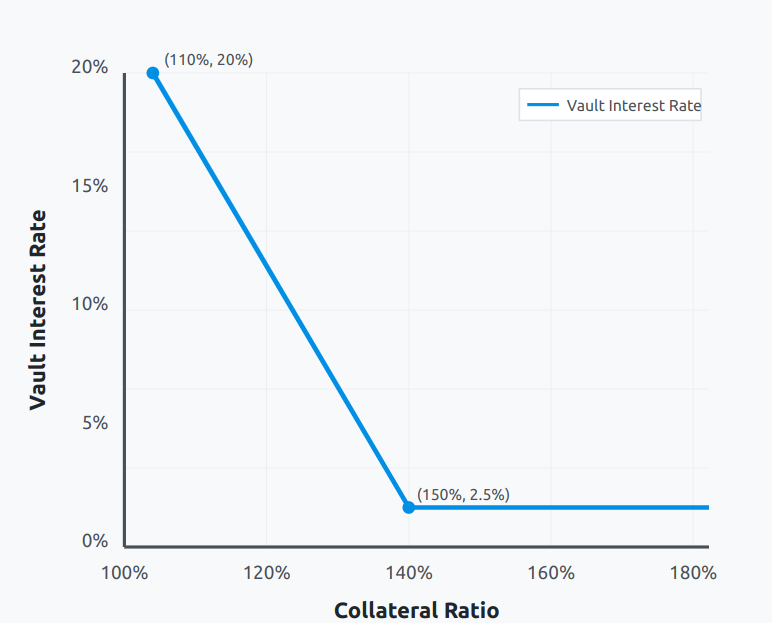
The Keiko Protocol implements a dynamic interest rate model for its Vaults, which is tailored to the collateral type used within each Vault. This model is designed to adjust interest rates based on the Collateral Ratio of the Vault, thereby affecting the cost of borrowing based on the security provided by the borrower's collateral.\ <br>

### Parameters Defining Interest Rates

* **Base Fee**: This is the minimum interest rate charged on loans within the Vault. It applies under conditions of high collateral security.
* **Max Fee**: This represents the maximum interest rate that can be charged in scenarios where the collateral security is lower.
* **Interest Range**: Defined between the Minimum Collateral Ratio (MCR) and the maxRange parameter, this range sets the bounds within which the interest rate scales.

### Interest Rate Calculation

Interest rates within a Vault are calculated based on the current Collateral Ratio, which compares the total value of the collateral to the total borrowed amount, expressed as a percentage.\
\
Lets see an example with the following collateral parameters:

* **Minimum Fee**: 2.5%
* **Maximum Fee**: 20%
* **MCR Minimum Range**: 110%
* **MCR Max Range**: 150%

**Collateral Ratio Above 150%**: When the Collateral Ratio exceeds **Max Range** (150%), the interest rate charged will be at the **Base Fee** of 2.5% reflecting that the vault has a low risk for the protocol.\
\
**Collateral Ratio Between MCR and Max Range (110% to 150%)**: Within this range, the interest rate increases linearly from the Base Fee at 150% to the Max Fee at 110%. This scaling is designed to incrementally increase the cost of borrowing as the risk associated with the loan the vault is taking increases.

<figure><img src="/files/dNc2rEWwljoHdbxbEDwZ" alt=""><figcaption></figcaption></figure>

This interest rate model allows Keiko Protocol to adjust borrowing costs dynamically in response to changes in the risk associated with active vaults. By doing so, it aims to balance the risk for the protocol while providing fair and competitive rates for borrowers based on their collateral's stability.<br>


# Redemptions Model

The Keiko Protocol's Vault redemption model ensures that KEI stablecoin maintains its peg by allowing 1:1 redemption of KEI for the collateral held in Vaults, albeit with an associated fee. This feature is crucial for maintaining the price stability of KEI and providing a fail-safe mechanism for holders.

### Redemption Mechanism&#x20;

**1:1 Redemption**: Anyone can redeem KEI 1:1 for the collateral in any Vault, subject to a transaction fee. This mechanism is designed to ensure that KEI never falls below its target price.

#### Calculation of Redemption Priority

* **Nominal Collateral Ratio (NCR)**: This is calculated as the Collateral value divided by the Debt value for each vault.

$$
NCR = Collateral / Debt
$$

* **Minimum Collateral Ratio (MCR)**: Each vault has an MCR defined, which is critical for determining its financial health.
* **MCR Factor**: A parameter used to tweak the weight of the MCR Component.
* **MCR Component**: This is derived by multiplying the vault’s MCR by the mcrFactor.

$$
MCR Component = mcrFactor \* MCR
$$

#### Adjusted Redemption Score (ARS)

$$
ARS = NCR + mcrComponent
$$

* The ARS for each vault is calculated by adding the Nominal Collateral Ratio (NCR) to the MCR Component.
* The ARS determines the order in which vaults are redeemed; the vault with the lowest ARS is given priority in redemption.
* Vault owners can increse their ARS by increasing their NCR and their MCR


# ARS Simulations

We did simulations with a big dataset of random Keiko vaults to explore the Adjusted Redemption Score (ARS), a metric that builds upon the traditional Normalized Collateral Ratio (NCR) by incorporating additional risk factors.\
\
You can run the simulations yourself and modify the parameters used by executing the 'simulations.py' python script that you can find on this github repo:

> <https://github.com/KeikoFinance/keiko-data>

### Key Insights

1. **Risk Sensitivity**: The ARS provides a more sensitive measure of redemption risk. While the NCR might suggest similar risk levels for vaults with the same collateral-to-debt ratio, the ARS can differentiate based on the specific MCR requirements.
2. **System Adaptability**: The MCR Component in the ARS allows the system to adapt to changing market conditions or risk preferences by adjusting how the MCR influences the overall score.
3. **Risk Distribution**: The ARS creates a wider spread of risk scores compared to NCR alone. This allows for more granular risk categorization and potentially more precise liquidation or incentive mechanisms.
4. **Collateralization Incentives**: By incorporating the MCR into the risk score, the ARS may encourage users to maintain higher collateralization ratios relative to their specific vault requirements, potentially increasing overall system stability.
5. **Complex Risk Factors**: The ARS can potentially incorporate more complex risk factors through adjustments to the MCR Component calculation, allowing for a more sophisticated risk assessment model.

### 100 Vaults Sample Data (simulation.py)

<figure><img src="/files/Nv8P8HJjpzXqT9jMD7uk" alt=""><figcaption></figcaption></figure>

<figure><img src="/files/8YcbjT1QxG0BLtv7LX1Q" alt=""><figcaption></figcaption></figure>

With an MCR\_Factor of 0.2, we obtain the following results:

* Average Impact: 21.11%
* Median Impact: 19.22%
* Minimum Vault Impact: 0.97%
* Maximum Vault Impact: 52.23%

In this context, "Impact" refers to the relative weight of the MCR (Minimum Collateralization Ratio) component in the ARS (Adjusted Redemption Score) compared to the NCR (Normalized Collateralization Ratio) component. Our current goal is to achieve an average impact of approximately 20%. Given these results, an MCR\_Factor of 0.2 appears to be an appropriate choice.

This factor allows for a balanced influence of both MCR and NCR components in the ARS Score calculation, with the MCR component contributing, on average, about one-fifth of the total score.&#x20;

###

### Data Visualization

<figure><img src="/files/W0ZQ2aEYmswa8lSQkCjy" alt=""><figcaption><p>collateral_debt_ratio_vs_mcr_impact</p></figcaption></figure>

<figure><img src="/files/0QDwP2hCHt3wotiycckm" alt=""><figcaption><p>correlation_heatmap</p></figcaption></figure>

<figure><img src="/files/5KikSQeC9wYVbuW6LvGa" alt=""><figcaption><p>mcr_impact_distribution</p></figcaption></figure>

<figure><img src="/files/wKB7a3RISERoZjXjcoQw" alt=""><figcaption><p>ncr_vs_ars_impact_zoomed</p></figcaption></figure>


# Immutability and Admin Powers

Keiko smart contracts are designed with immutability as a core principle. This design choice ensures that the fundamental logic of the protocol cannot be altered, providing users with a guarantee that the contracts will consistently behave as expected, without unexpected changes. While this immutability is a significant step towards ensuring the protocol's security, it's important to note that it does not preclude the existence of administrative capabilities that can modify certain protocol parameters.\
\
In the interest of complete transparency and to keep users fully informed of potential risks, we provide a comprehensive overview of the administrative powers within the Keiko protocol.

## Parameters Defined by the Contract Owner

The contract owner, through designated administrative functions, has the ability to modify several key protocol parameters. These powers include, but are not limited to:

* Collateral Management: Powers to add new collateral types and set their parameters, including Minimum Collateral Ratio (MCR), MCR Factor, Maximum MCR Range, Base Fee, Maximum Fee, Minimum Net Debt, Mint Cap, and Liquidation Penalty.
* Collateral Parameter Adjustments: The ability to modify individual collateral parameters such as minimum and maximum ranges, MCR factor, base and maximum fees, minimum net debt, mint cap, and liquidation penalty.
* Collateral Activation: The power to activate or deactivate specific collateral types within the protocol.
* Fee Management: Authority to set the redemption fee for the protocol.
* Oracle Management: The ability to set and manage price feed oracles. This is a critical power, so it is subject to a 3-day timelock period.
* KEI Token Management: Powers related to whitelisting addresses for minting and burning KEI tokens. This is a critical power, so it is subject to a 14-day timelock period.
* Stability Pool Management: Powers to add new collateral types to the Stability Pool.
* Interest Distribution: The ability to set recipients for protocol interest distribution and define a default interest recipient.
* Ownership Management: The ability to transfer ownership of the contracts or renounce ownership entirely.


# Risk Mitigations

When interacting with Keiko smart contracts, users should be aware of the following security measures and potential risks:

## Protocol Multisig

The Keiko protocol's ownership is controlled by a 3-of-5 multisig wallet managed by the team. This security measure ensures that an attacker would need to compromise at least three keys from three different team members to gain access to the contract ownership. This significantly reduces the risk of unauthorized access and malicious changes to the protocol.

## Parameter Safeguards

As mentioned in the previous section, the core smart contracts of the protocol are immutable. This design choice prevents an attacker from upgrading the contracts or implementing custom logic to directly steal user funds. Any potential attacker would be constrained by the existing protocol logic.\
\
However, an attacker with access to the multisig could potentially modify collateral parameters in an attempt to manipulate the system, grief it or mint unlimited amounts of KEI. To mitigate this risk, we have implemented hardcoded safeguards on critical collateral parameters:<br>

* Minimum Collateral Ratio: Set at 100%, preventing an attacker from setting the MCR below this threshold. This safeguard ensures that KEI cannot be minted without sufficient backing.
* Maximum Interest Rate: Capped at 100%, preventing an attacker from setting an excessively high interest rate that could exponentially increase the debt of user vaults.
* Maximum Liquidation Penalty: Limited to 30%, preventing an attacker from setting an unreasonably high liquidation rate that could extract disproportionate amounts of funds during liquidations.
* Maximum Redemption Fee: Capped at 10%, ensuring that an attacker cannot set an excessively high redemption fee. This maintains KEI's price floor at $0.90 or higher, preserving its stability and value.<br>

These safeguards provide an additional layer of protection for users, even in the unlikely event of a compromise of the multisig wallet. By implementing these limits, we aim to maintain the integrity and stability of the Keiko protocol under various threat scenarios.


# Points Program

The Keiko Points Program aims to meaningfully reward early users who helped grow the Keiko ecosystem by taking risks and demonstrating faith in the project during its formative stages.

## Program Duration

The Keiko Points Program kicked off on **March 1, 2025**, establishing a method to reward early community participation before the token launch. This program is divided into two distinct seasons of 12 weekly distributions each (∼3 months / season), creating a six-month engagement period for community members to accumulate points based on their activity and contributions.

Each week, 1 million points are distributed to active participants, with a total of 12 million points allocated per season. By the conclusion of the program, a grand total of 24 million points will have been distributed across the entire community. This methodical approach ensures consistent engagement opportunities while creating a fair mechanism to identify and reward the most dedicated community members.\
\
The entire 24 million point pool will be transformed into tokens as part of the Genesis Distribution

## Distribution Criteria

* **Active vault time:** the longer your vault remains active in the Keiko ecosystem, the more points you steadily accumulate over time. This mechanism incentivizes long-term participation and rewards users who maintain their vaults throughout both seasons of the program.
* **Amount of KEI borrowed:** borrowing larger amounts of KEI increases your weekly point earnings.
* **Stability Pool deposits:** by depositing funds into the StabilityPool, users help maintain system stability by providing a mechanism to absorb debt from liquidated vaults, earning weekly points proportional to their deposit size. Beyond points, participants also earn liquidation rewards from any liquidated collateral, creating a dual-incentive model.
* **Liquidity provision on AMMs: l**iquidity providers who support KEI trading pairs on partner platforms like Kittenswap or HyperSwapX earn significant point allocations while helping create deep liquidity markets.

## Season 1  — Progress

| Weekly Distribution         | Status                   |
| --------------------------- | ------------------------ |
| Mar 1, 2025 - Mar 8, 2025   | Distribution Completed   |
| Mar 8, 2025 - Mar 15, 2025  | Distribution Completed   |
| Mar 15, 2025 - Mar 22, 2025 | Distribution Completed   |
| Mar 22, 2025 - Mar 29, 2025 | Distribution Completed   |
| Mar 29, 2025 - Apr 5, 2025  | Distribution Completed   |
| Apr 5, 2025 - Apr 12, 2025  | Distribution Completed   |
| Apr 12, 2025 - Apr 19, 2025 | Distribution Completed   |
| Apr 19, 2025 - Apr 26, 2025 | Distribution Completed   |
| Apr 26, 2025 - May 3, 2025  | Distribution Completed   |
| May 3, 2025 - May 10, 2025  | Distribution Completed   |
| May 10, 2025 - May 17, 2025 | Distribution Completed   |
| May 17, 2025 - May 24, 2025 | Distribution in Progress |
| May 24 - May 31, 2025       | End of Season 1 ;)       |


# TGE Allocations

Below can be found detailed information about KEIKO distribution and details about each allocation. This comprehensive breakdown explains how the token supply will be distributed across various stakeholders and initiatives, ensuring transparency about the project's tokenomics structure.

## Keiko TGE Allocations

<figure><img src="/files/vC9y3qZ1tQUm2JCdvk2j" alt=""><figcaption></figcaption></figure>

<figure><img src="/files/PDoN9BNXYT1LgER3f9qr" alt=""><figcaption></figcaption></figure>

<figure><img src="/files/7XlV0yjUpqhOj6LP2tL9" alt=""><figcaption></figcaption></figure>

## Allocation Information

**18.5% - Team and Future Contributors:** this allocation rewards the founding team members and reserves tokens for future contributors who will join the project as it grows. The tokens will be subject to a vesting schedule to ensure alignment with the project's success.\
\
**7.5% - Public Raise:** Keiko V1 was developed entirely through self-funding by the team, deliberately avoiding privileged actors like venture capital firms in private seed rounds. This public raise maintains that ethos by inviting the broader community to participate directly in funding the project's future, ensuring no single entity has disproportionate influence. The funds raised will be deployed for Keiko V2 development, comprehensive security audits, a potential ticker auction, and other critical infrastructure needs that will benefit all participants equally, creating a fair launch environment that aligns with the project's core values.<br>

**28% - Genesis Distribution:** the Genesis Distribution allocates tokens directly to participants in the Keiko Points Program, rewarding users who actively engaged with the protocol during its early stages. This significant portion of the total supply will be distributed proportionally based on points accumulated through maintaining active vaults, borrowing KEI, providing stability pool deposits, and supplying liquidity.

**42.25% - Future Community Rewards:** the largest allocation is reserved for ongoing community incentives, including V2 incentives, grants, and ecosystem development initiatives. This substantial portion ensures the project can sustainably reward participation, aligning with a long-term vision of community ownership and creating continuous incentives for new users to join the ecosystem.

**1.25% - Notable Community Contributions:** this allocation recognizes exceptional individuals who made significant contributions to the project before the token launch, such as community builders, content creators, or contributors to public good on the Hyperliquid ecosystem.

**2.5% - HIP-2:** the HIP-2 allocation refers to tokens reserved for liquidity purposes on HyperCore.


# KEIKO V2


# Collateral Strategies

### What Are Collateral Strategies?

**Collateral Strategies** let you earn yield on your vault collateral while keeping your borrowed USDK. Instead of having all your collateral sit idle, you can deploy a portion to earn interest on platforms like Hyperlend or HypurrFi.

**Key benefit:** Your collateral continues to back your borrowed USDK while simultaneously earning yield.

***

### How It Works

#### Your Collateral is Split Into Two Parts

When you use Collateral Strategies, your collateral is divided:

1. **Direct Collateral** - Stays in your vault for security (can't be deployed)
2. **Deployable Collateral** - Extra collateral you can send to earn yield

**Example:**

* You have 2 BTC in your vault ($100,000 value)
* You've borrowed $50,000 USDK
* The protocol requires you keep at least 1.3 BTC directly in the vault for safety
* **You can deploy up to 0.7 BTC** to earn yield while your debt stays the same

#### Why Keep Direct Collateral?

The protocol enforces a **Safety Buffer** (default: 20% above the liquidation threshold) to protect your vault:

* **Prevents liquidation** if deployed strategies temporarily can't return funds
* **Maintains healthy vault** even during market volatility
* **Keeps your borrowing power** intact

#### Yield Sources

You can choose from multiple vetted DeFi protocols:

* **Hyperlend V3** - Lending protocol
* **HypurrFi** - Lending protocol
* More options added over time

Each protocol has different yields and risks. Choose based on your preference.

***

### Safety Features

#### Automatic Protection

If your vault becomes unsafe due to price movements or other factors, the protocol has built-in protection:

**Safety Monitors** - Automated bots (keepers) monitor all vaults 24/7. If your direct collateral falls below the safety threshold, keepers can trigger an automatic withdrawal from your yield strategies to protect your vault.

**Small Fee** - If a keeper needs to rescue your vault, they receive a small fee (0.5% default) from the withdrawn amount. This incentivizes them to keep the protocol safe.

**You Stay Safe** - Even if you're not actively monitoring, your vault won't get liquidated due to deployed collateral.

#### What Happens During Emergency Withdrawals

1. System detects your direct collateral is too low
2. Keeper triggers withdrawal from your yield strategies
3. Collateral is returned to your vault
4. A small fee goes to the keeper
5. Your vault is safe again

**Note:** You can always withdraw your collateral yourself before keepers need to intervene.

***

### How to Use Collateral Strategies

#### Deploying Collateral

1. **Check Available Amount** - The interface shows how much you can deploy
2. **Choose a Strategy** - Select from available yield sources (Hyperlend, HypurrFi, etc.)
3. **Enter Amount** - Deploy up to your available limit
4. **Confirm** - Your collateral starts earning yield immediately

Your total collateral value doesn't change - it's just split between direct (in vault) and deployed (earning yield).

#### Withdrawing Collateral

You can withdraw your deployed collateral anytime:

1. **Click Withdraw** - From your vault's strategy section
2. **Confirm** - The system retrieves from all strategies automatically
3. **Receive** - Collateral plus any earned yield returns to your vault

**Note:** Withdrawals are usually instant, but may occasionally have small delays depending on the external protocol's liquidity.

#### Claiming Yield

Instead of withdrawing everything, you can claim just the yield earned:

1. **Check Earned Yield** - Displayed in your vault interface
2. **Click Claim Yield** - Keeps your principal deployed
3. **Receive** - Yield is added to your vault collateral

This increases your collateral without interrupting your yield strategy.


# Security and Audits

Apart from internal security reviews, the Keiko codebase has been externally audited by [CD Security. ](https://cdsecurity.site/)You can check the audit report below:

{% file src="/files/4GnHcohtfwqF2qrhdbTj" %}

We engaged with [Kupia Security](https://www.kupia.io/) for our 2nd audit of the Keiko codebase. You can check the audit report below:<br>

{% file src="/files/FWGb79S4z78Q2kLx41Rn" %}


# Protocol Contracts

Mainnet Contracts

<table><thead><tr><th>Contract Name</th><th>Address</th><th data-hidden></th></tr></thead><tbody><tr><td>VaultManager</td><td>0x4460c8693079f91452454B18d263ae0d7749aeDb</td><td></td></tr><tr><td>VaultOperations</td><td>0x67e70761E88C77ffF2174d5a4EaD42B44Df3F64a</td><td></td></tr><tr><td>VaultSorter</td><td>0x80D6F680675d1a2a57545DCDc5f0a0604699aa70</td><td></td></tr><tr><td>StabilityPool</td><td>0xb22f7B5d5724B1a454d6811456C85491C1BB249b</td><td></td></tr><tr><td>PriceFeed</td><td>0x74871e04129D323b85334F94F9A4b6a4B9C238D7</td><td></td></tr><tr><td>KEI</td><td>0xB5fE77d323d69eB352A02006eA8ecC38D882620C</td><td></td></tr><tr><td>KEIKO</td><td>Not deployed</td><td></td></tr><tr><td>HYPE</td><td>0x5555555555555555555555555555555555555555</td><td></td></tr><tr><td>wstHYPE</td><td>0x94e8396e0869c9F2200760aF0621aFd240E1CF38</td><td></td></tr></tbody></table>

Testnet Contracts

<table><thead><tr><th width="319">Contract Name</th><th>Address</th></tr></thead><tbody><tr><td>VaultManager</td><td>0xf43e6f98C9f89b032f369742A331911B4d2C4E65</td></tr><tr><td>VaultOperations</td><td>0xE3fCA31B736541b9a7Ae6F7ad65102affd7D37d4</td></tr><tr><td>VaultSorter</td><td>0xc934aC59D99e77c52167883c4bFdEfF35F7c6102</td></tr><tr><td>StabilityPool</td><td>0x90235DDCeb3Afdbb53d9648242Ed95Ac05a90ACa</td></tr><tr><td>PriceFeed</td><td>0x423b03bBe9ed20354C4BBca391554ccc1d024b8E</td></tr><tr><td>KEI</td><td>0xE1A78f5B2FC080d7F34c47d703f19533097Ee34a</td></tr><tr><td>KEIKO</td><td>Not Deployed</td></tr><tr><td>HYPER</td><td>0x798049cf4F9f25B35AF3514c19Fde0D835a6a31A</td></tr><tr><td>PURR</td><td>0x2934907f5f050aB2233784dF4992Ab2591Fb6753</td></tr></tbody></table>